
Why Sharks Are Important, and Why That Should Change How You See Them

Updated: Aug 4
Sharks play a key ecological role within marine ecosystems. As apex and mesopredators[1], they help regulate populations of other species and influence their behaviour, contributing to healthier coral reefs, seagrass meadows and open ocean ecosystems.
Research has shown that highly migratory sharks feeding in the open ocean and then moving in towards reefs carry nutrients with them, effectively fertilising those reefs and helping them stay productive.
Despite being misunderstood and often feared, the vast majority of shark species pose no threat to humans. Sharks contribute to the health of the oceans, the wildlife that depends on them, and the ecosystems that provide food, livelihoods and many of the natural processes upon which our planet relies.
Every July, Shark Week brings millions of people closer to these fascinating animals. Television screens fill with images of great white sharks breaching from the water, close encounters with divers, and stories that remind us why sharks have captured our imagination for centuries.
For many people, however, sharks evoke something else entirely: fear.
That reaction is understandable. Few wild animals have been portrayed as consistently as dangerous predators. Films, newspaper headlines and social media often focus on the rare occasions when sharks bite people, while overlooking the far more important story. Sharks are among the oldest vertebrates on Earth and have helped shape marine ecosystems for more than 450 million years.
Without healthy shark populations, our oceans would not function in the same way.
That may sound like an exaggeration, but scientists increasingly recognise sharks as one of the key groups responsible for maintaining healthy marine ecosystems. As apex predators, they influence the behaviour, abundance and distribution of other species. Their presence helps maintain balance across food webs that extend from tropical coral reefs to deep-sea environments and vast seagrass meadows.
Healthy oceans produce a significant proportion of the oxygen we breathe, regulate the Earth's climate, absorb carbon dioxide and provide food and livelihoods for hundreds of millions of people. Protecting sharks is therefore about far more than conserving a single group of animals. It is about safeguarding the health and resilience of marine ecosystems upon which both wildlife and people depend.
What Yellowstone's wolves can teach us about sharks
The clearest way to understand why a top predator matters is to look at what happens when one is taken away and then brought back. When wolves were hunted out of Yellowstone National Park in the United States, elk populations increased and spent long periods grazing in river valleys. Young willow and aspen trees struggled to regenerate. Beavers lost the trees they relied upon for food and dam building. Wetlands declined, affecting fish, amphibians, birds and countless other species.
When wolves were reintroduced in 1995, they certainly hunted elk, but perhaps more importantly, they changed the elk's behaviour. Grazing animals became more cautious and spent less time feeding in vulnerable river valleys. Vegetation recovered. Willow and aspen regenerated. Beaver populations increased, creating wetlands that supported fish, insects, birds and mammals. The effects rippled throughout the ecosystem in what ecologists call a trophic cascade.
The return of a top predator helped restore balance across an entire landscape.
The lesson ecologists drew from Yellowstone is that a predator does far more than kill prey. It shapes the behaviour and balance of the entire system around it, and much of that influence stays invisible until the predator is gone.
The Public Broadcasting Service's learning resource on the wolves of Yellowstone lays this out clearly and is a good way to see the principle in action.

Sharks play the same role in the ocean. Although we cannot observe changes at the scale of an entire ocean as we can in Yellowstone, the same predator-and-prey chain reaction, which ecologists call a trophic cascade, has been documented on coral reefs.
Work led by researchers at the Scripps Institution of Oceanography found that Caribbean reefs with healthy shark populations were healthier overall. Where sharks had been fished out, their prey, including grouper, increased. The grouper ate more of the parrotfish that normally graze algae off the coral, algae took over, and the reef degraded. This is one example of how removing apex predators can alter food webs, although the exact effects vary between ecosystems.
Scientists continue to study these complex interactions, and there is still much to learn. However, one message is becoming increasingly clear. Removing apex predators from marine ecosystems can trigger consequences that extend far beyond the sharks themselves.
The story of Yellowstone reminds us that protecting predators is often about protecting entire ecosystems.
Are sharks actually dangerous to people?
The honest answer is that the risk exists but vanishingly small, far too small to justify the fear most people feel.
In a world of eight billion people, sharks are responsible for a very small number of human deaths each year (six or seven).
Set that against the animals we rarely fear.
Mosquitoes kill more than 750,000 people annually
Snakes account for roughly 100,000 deaths
Dogs around 25,000
Hippos, crocodiles and cows each cause far more human fatalities every year than sharks do

The odds of a person being killed by a shark are somewhere in the order of 1 in 3.7 million.
In comparison, researchers estimate that the number of sharks killed by fishing increased from at least 76 million in 2012 to around 80 million in 2019, with roughly 25 million of those belonging to species already threatened with extinction.
A nationwide survey commissioned by Bite-Back found that nearly half of Britons think sharks are more terrifying than spiders, snakes and rodents combined, and that 64 per cent would prefer sharks did not exist at all. That last figure should give anyone who cares about the ocean pause, because it is very difficult to build public support for protecting an animal that most people would rather were gone.
It helps to understand what is actually happening when a shark investigates something in the water. Large sharks explore objects with their mouths, in much the same way other animals use their paws or snouts, because they have no other way to examine what they encounter. A bite is not the same as an attack, and the mere presence of a shark near a beach or a boat is not evidence of any intent to harm. Most sharks are timid and easily frightened, and the majority of encounters end with the shark leaving.
More than just great white sharks


When most people picture a shark, they imagine a large predator with rows of sharp teeth, perhaps a great white shark swimming through open water.
In reality, more than 500 recognised shark species inhabit the world's oceans, ranging from shallow coral reefs to the deepest parts of the sea. They vary in size, appearance, behaviour and diet.
The largest of all is the whale shark, which can grow to around 18 metres in length. Despite its size, it feeds almost entirely on plankton, filtering tiny organisms from the water with remarkable efficiency. Swimming alongside a whale shark is often described as one of the most peaceful wildlife encounters in the ocean.


The smallest, the dwarf lantern shark, is about the length of a pencil. Between those two extremes sits a significant range of form and behaviour.

Some sharks barely fit the picture at all. The epaulette shark can walk across exposed reef and dry land on its fins for up to 30 metres to reach new tidal pools.

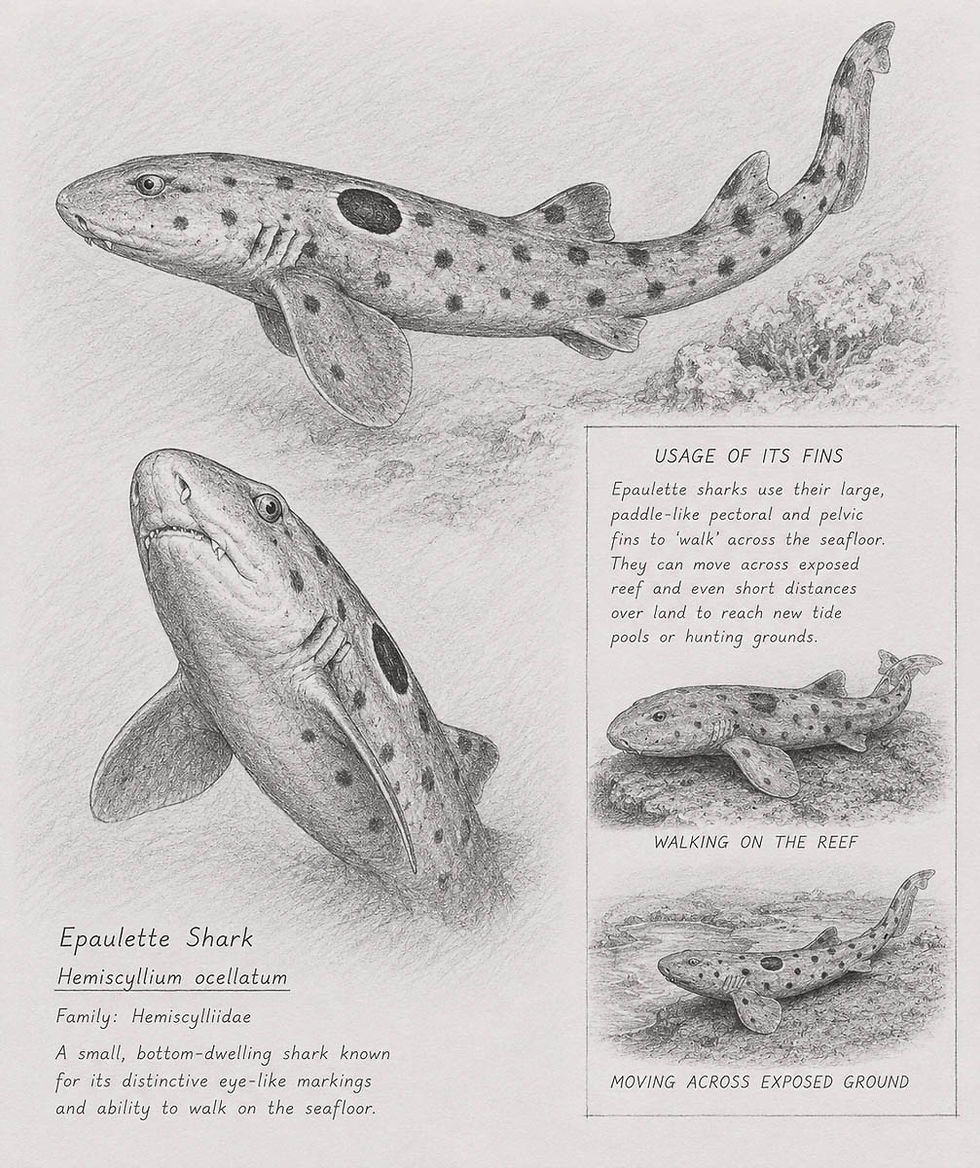
The tasselled wobbegong lies camouflaged on the seabed, its skin fringed with growths that look exactly like seaweed, and ambushes prey that wanders too close.


Some sharks are built for speed. The shortfin mako is among the fastest fish in the ocean, capable of short bursts of acceleration while pursuing tuna and other fast-moving prey.


The cookie-cutter shark, only a few tens of centimetres long, attaches to larger animals and removes a neat circular plug of flesh.

The frilled shark and the goblin shark are so old and so unchanged that they are often called living fossils.


The Greenland shark can live for more than 400 years, with some estimates exceeding 500 years, making it the longest-lived vertebrate known to science.


Sharks are closer to home than most people realise, too. Dozens of species live in or visit British and European waters, including the basking shark, a harmless plankton feeder and the second-largest fish in the world, which appears off the south-west coast of Britain in the summer months.


The reality is that there is no such thing as "the shark".
There are hundreds of species, each occupying a different ecological role, each facing different conservation challenges, and the overwhelming majority pose little or no threat to humans.
Recognising this diversity is one of the first steps towards understanding why sharks deserve to be appreciated.
Why sharks are important to healthy oceans
Predators are often judged by what they eat, but their greatest ecological influence often comes from what they prevent. Throughout nature, predators help regulate populations, influence behaviour and maintain the balance between species, and marine ecosystems are built upon countless interactions between predators, herbivores and the habitats they depend upon. Without these relationships, ecosystems can become increasingly unstable.
One of the most important roles played by sharks is controlling populations of prey and mid-level predators. By removing weak, sick or injured individuals, they contribute to healthier populations while reducing the likelihood that a single species becomes overly abundant. Equally important is the effect sharks have simply by being present. Many marine animals adjust their movements and feeding behaviour when sharks are nearby, spending less time grazing in exposed areas, avoiding certain habitats at particular times and moving more frequently through the landscape.
This constant movement can have profound ecological consequences. In Shark Bay, Western Australia, tiger sharks influence where dugongs and green turtles feed. Rather than remaining in one location and consuming large amounts of seagrass, these herbivores become more cautious and move between different feeding areas. The result is healthier seagrass meadows, which are among the most valuable ecosystems on Earth: they provide shelter for juvenile fish, stabilise sediments, improve water quality and store significant amounts of carbon, and hundreds of marine species depend upon them during part of their lives.


The sharks are not protecting the seagrass directly. Instead, their presence influences the behaviour of herbivores, allowing the ecosystem to remain in balance. It is a reminder that predators shape ecosystems in ways that extend far beyond the animals they hunt.
Sharks are important because they help sustain the ecosystems upon which countless other species, including ourselves, ultimately depend.
The oceans produce over fifty percent of the oxygen of our planet. This vital supply comes primarily from microscopic marine plants called phytoplankton, algae, and certain bacteria performing photosynthesis near the water's surface. A single tiny bacterium called Prochlorococcus alone produces up to 20% of the oxygen in our entire biosphere, more than all the world's tropical rainforests combined. The oceans also regulate global climate, support fisheries, transport nutrients around the globe and sustain a large share of life on Earth.
Protecting sharks is one part of protecting that wider system, because conserving predators is not simply about saving individual species. It is about maintaining the natural relationships that keep ecosystems functioning. When we protect sharks, we help protect coral reefs, seagrass meadows, fisheries, marine biodiversity and, ultimately, the health of the oceans themselves.
What is really threatening sharks
Having survived for more than 450 million years, sharks have endured dramatic changes in the Earth's history, including multiple mass extinction events. Ironically, one of their greatest challenges has emerged only within the last few decades.
Unlike many bony fish, most sharks grow slowly, reach maturity late in life and produce relatively few young. Some species may take more than a decade before reproducing for the first time, while others produce only a handful of pups every few years. This life history has served sharks well for millions of years in relatively stable oceans, but it leaves many species particularly vulnerable to modern fishing pressure.
A global reassessment by the IUCN, published in 2021 and drawing on almost 1,200 species, found that roughly a third of all sharks, rays and related fish are now threatened with extinction. The first assessment, in 2014, put the figure at a quarter. That deterioration in less than a decade places sharks and rays among the most threatened groups of vertebrates on the planet, second only to amphibians.
Today, sharks face a combination of threats rather than a single challenge.
Commercial fishing remains the most significant.
Some sharks are deliberately targeted for their meat, fins, liver oil or cartilage. Others are caught unintentionally as bycatch in fisheries targeting tuna, swordfish and other commercially valuable species. Sharks are also highly susceptible to the stress of capture.
Many that are thrown back alive die within hours, because the build-up of lactic acid in their bodies after a struggle is often fatal, even when the animal appears to swim away unharmed.
Habitat degradation also affects coastal shark species. Mangroves, estuaries and seagrass meadows that serve as nursery areas continue to disappear in many parts of the world through coastal development and pollution. Climate change is altering ocean temperatures, shifting species distributions and placing additional pressure on marine ecosystems that are already under stress.
Where Bite-Back comes in

Conservation often begins long before new laws are introduced or marine protected areas are established.
It begins by changing the way people think.
Few organisations illustrate this better than Bite-Back Shark & Marine Conservation.
Founded after its campaign director began asking a simple question "What happens if we meet a shark?". Conversations with experienced divers revealed something unexpected. Sharks had become noticeably less common than they had been only a few decades earlier.
That observation led to a much deeper question.
Why were sharks disappearing?
The answer extended far beyond fear of sharks themselves. It included consumer choices, commercial fishing, media representation and a widespread lack of understanding about the ecological importance of sharks.
Bite-Back Shark and Marine Conservation was founded in the UK in 2004, and its approach is unusual. Rather than campaigning at sea, it works on the high street, targeting the commercial demand that gives a dead shark its value. The logic is straightforward.
Remove the profit and you remove much of the incentive to kill.
One of the charity's longest-running campaigns focused on a legal loophole that allowed travellers entering the UK to bring in up to 20 kilograms of dried shark fins for personal use, enough to make hundreds of bowls of shark fin soup. Following years of campaigning by Bite-Back alongside organisations including Shark Trust and Shark Guardian, the Shark Fins Act 2023 received Royal Assent on 29 June 2023. The Act banned the import and export of detached shark fins and products containing them, including tinned shark fin soup. It was a measurable example of how sustained public campaigning can contribute to legislative change.

According to Bite-Back, its campaigning has contributed to an 82 per cent reduction in the number of UK restaurants serving shark fin soup, including the country's only Michelin-starred Chinese restaurant. It persuaded Asda to stop selling shark steaks, prompting Iceland Foods, Makro and dozens of smaller businesses to do the same. It also convinced Holland & Barrett to remove shark cartilage capsules from its 580 stores and, working with Westminster Trading Standards, helped expose a prominent London restaurant that was illegally importing shark fins.
Bite-Back has also worked to change the way sharks are portrayed in the media. Its guidance for journalists encourages accurate reporting of shark encounters, discourages sensational terms such as "monster", "killer", "beast" and "man-eater", and recommends using images and language that better reflect the diversity of sharks rather than reinforcing fear. The aim is simple: help people see sharks as an essential part of healthy oceans rather than as animals defined by the rare occasions when they encounter humans.

Together, these campaigns demonstrate that conservation does not always begin in the ocean. Sometimes it begins in supermarkets, restaurants, classrooms and newspapers, by changing the decisions people make every day
Education has remained central to Bite-Back's work.
The organisation has developed educational resources for schools, helping young people discover the diversity of sharks, understand their ecological role and challenge the misconceptions that have surrounded them for decades. Rather than presenting sharks as animals to fear, these resources encourage curiosity, critical thinking and scientific understanding.

More recently, the organisation has drawn attention to another important issue: bycatch in tuna fisheries.
Consumers often assume that purchasing a tin of tuna has little connection with shark conservation. In reality, the fishing methods used can make a significant difference.
Pole-and-line fishing targets individual tuna using a single hook and line, dramatically reducing the accidental capture of sharks and many other marine species compared with some industrial fishing methods. By encouraging consumers to look for responsibly sourced, pole-and-line caught tuna, Bite-Back helps people make informed purchasing decisions that can reduce pressure on marine ecosystems.

How Indigo Earth Foundation Supports Bite-Back Shark & Marine Conservation
At Indigo Earth Foundation, we believe conservation is strengthened through collaboration.
Around the world, dedicated organisations are working to protect wildlife, restore ecosystems and support local communities. By promoting their work, sharing their stories and helping connect them with new supporters, we aim to amplify the impact they are already making.
Bite-Back Shark & Marine Conservation is one of those organisations.
Its combination of education, public engagement, consumer awareness campaigns and policy influence demonstrates that changing perceptions can lead to tangible conservation outcomes. From helping remove shark fin soup from restaurant menus and shark steaks from supermarket shelves to promoting responsible seafood choices and encouraging more accurate media reporting, the organisation has shown that informed individuals can help drive lasting change.
Our support focuses on increasing awareness of Bite-Back's work and helping more people discover the importance of shark conservation.
You can learn more about the organisation and the projects it leads by visiting our dedicated Bite-Back Shark & Marine Conservation page.
What you can do
Shark Week is a good moment to move from watching to helping. The most useful steps fall into four groups, and none of them are difficult.
Support Bite-Back directly
As a charity, Bite-Back depends on donations and regular supporters, and even small monthly contributions add up to the funding that keeps its campaigns running.
Donate or become a member through the Bite-Back website at www.bite-back.com.
Follow the charity on social media and share its posts (Instagram, Facebook, X). This is free and genuinely useful, because widening the audience for accurate shark stories is part of the work.
Report shark products. If you see shark fin soup, shark steak, shark cartilage supplements or any shark-derived product for sale in a shop, restaurant or fishmonger in the UK, tell Bite-Back and they will work to have it stopped.
Choose fish more carefully, wherever you live
A large share of shark deaths is bycatch from fisheries chasing tuna and other high-value fish, so what goes in the shopping basket genuinely matters, and this advice applies as much in France or the United States as in Britain.
Look for the Marine Stewardship Council (MSC) blue tick. It is an international certification, so it means the same thing on a tin in a French supermarket, a US grocery store or a UK shop: the fishery was independently assessed as sustainable and traceable, with limited impact on other marine life.

On tuna specifically, read past the brand and look at how it was caught. Labels reading pole-and-line, pole-caught, troll-caught or FAD-free indicate selective methods that catch one fish at a time and let non-target animals, including sharks, go. These are the ones to choose. In France, the equivalents on the label are "pêché à la canne" or "à la ligne".
Avoid the high-bycatch methods where you can identify them. Tuna caught by longline, or by purse seine using fish-aggregating devices (often marked FAD-associated), tends to catch far more sharks, turtles and other animals as bycatch.
If you want a second opinion, the Marine Conservation Society's Good Fish Guide in the UK and Seafood Watch in the United States both rate specific products, and Bite-Back publishes its own guide to avoiding tuna linked to shark bycatch on its website.
Avoid products made from sharks
Shark turns up under names that do not mention it. In some countries it appears on menus and fish counters as flake, rock salmon, huss, rigg or smoked dogfish, and it is used in some supplements and cosmetics. Skip shark fin soup, shark steak and shark cartilage capsules, and check the labels on health and beauty products for shark-derived ingredients such as squalene from shark liver.
Change the story, and use Bite-Back's materials to do it
The single most useful thing most people can do costs nothing. When you hear the idea that sharks are mindless killers, correct it, and give people the accurate picture instead: the epaulette shark that walks on land, the whale shark that eats plankton, the basking sharks off Cornwall, the fact that cows kill more people in Britain than all the world's sharks combined. Bite-Back makes this easy by providing ready-to-use material you can share and adapt.
The free Shout Out for Sharks education pack, produced with First News, is downloadable from the Bite-Back website. It is aimed at Key Stage 2 and 3 pupils and works equally well for anyone who wants a clear, fact-checked introduction to sharks, which makes it useful for teachers and parents.
Bite-Back's media guidelines set out how to report sharks accurately and which words feed the fear. They are a useful reference if you write, post or comment about sharks online.
Bite-Back's website and social channels carry campaign images, facts and posts built to be shared. Reposting these to your own Instagram, Facebook, LinkedIn or TikTok is one of the simplest ways to put the accurate story in front of people who will never read a conservation report.
To read more about Bite-Back Shark and Marine Conservation and the work we support, visit our partner page at www.indigoearthfoundation.com/organizations/bite-back-shark.
Looking Beyond Shark Week
Shark Week has inspired generations of people to look towards the ocean with curiosity and wonder.
It has introduced millions to species they may never encounter in the wild and has helped showcase the beauty and diversity of life beneath the surface.
But understanding sharks should not be limited to one week each year.
The future of sharks will not be determined by documentaries alone. It will depend on whether we choose to value healthy oceans, support responsible conservation and recognise that these remarkable animals are an essential part of marine ecosystems rather than simply symbols of fear.
Perhaps the most important lesson is that sharks are not defined by the rare moments when they encounter humans.
Like the wolves that transformed Yellowstone by restoring balance to an ecosystem, sharks quietly help maintain the balance of the sea.
#WhySharksAreImportant #SharkConservation #SharkWeek #BiteBack #MarineConservation #ShoutOutForSharks #SharkFinsAct #ApexPredators #SustainableSeafood #OceanConservation #IndigoEarthFoundation
The species illustrations in this article were generated with AI in a consistent pencil-plate style. Photographs of several of these sharks are rare or restricted, and using one visual language across the series makes the animals easier to compare. They are interpretations, not documentation, and the accompanying facts are drawn from published sources.
Sources and further reading
Bite-Back Shark and Marine Conservation, including the free education pack, media guidelines, tuna guide and ways to donate: www.bite-back.com
Indigo Earth Foundation partner page for Bite-Back: www.indigoearthfoundation.com/organizations/bite-back-shark
IUCN Shark Specialist Group / Dulvy et al. (2021), the global Red List reassessment finding around a third of sharks, rays and chimaeras threatened with extinction, published in Current Biology. https://www.sciencedirect.com/science/article/pii/S0960982221011982
IUCN, "Global Status of Sharks, Rays and Chimaeras" (2024), the Shark Specialist Group's status report: www.iucn.org
UK Government, Shark Fins Act 2023, which banned the import and export of detached shark fins from 29 June 2023: www.gov.uk/government/news/government-introduces-law-banning-international-shark-fin-trade
PBS LearningMedia, "Wolves of Yellowstone", a short resource on how returning an apex predator reshaped an entire ecosystem: www.pbslearningmedia.org/resource/a58e3ca2-52ab-45f5-87ac-26ee0d681146/wolves-of-yellowstone-earth-a-new-wild
Marine Stewardship Council, on fishing methods and the meaning of the blue tick: www.msc.org
Marine Conservation Society Good Fish Guide (UK): www.mcsuk.org, and Seafood Watch (US): www.seafoodwatch.org
National Ocean Service : How much oxygen comes from the ocean? https://oceanservice.noaa.gov/facts/ocean-oxygen.html
Our World in Data: What are the world’s deadliest animals, and can we protect ourselves against them? https://ourworldindata.org/deadliest-animals
Research Gate, Global shark fishing mortality still rising despite widespread regulatory change https://www.researchgate.net/publication/377329915_Global_shark_fishing_mortality_still_rising_despite_widespread_regulatory_change
[1] Many smaller shark species, like the Catshark, Pygmy shark, or Spiny Dogfish, are actually "middle-tier" predators. While they hunt smaller fish and crustaceans, they are also actively hunted by larger fish, marine mammals, and bigger sharks.


Comments