
How the Marine Megafauna Foundation Protects Sharks in Mozambique
- Indigo Earth Foundation

- 6 days ago
- 24 min read
Updated: 5 days ago
Sharks in Mozambique are protected through scientific research, national legislation, marine protected areas, fisheries studies and education. Much of this work depends on understanding where sharks travel, which habitats they repeatedly use and where fishing or other human activity places them at greatest risk.
The Marine Megafauna Foundation (MMF) has contributed to that work for more than 20 years. Research that began with manta rays and whale sharks in southern Mozambique has grown into a wider programme covering bull sharks, zebra sharks, wedgefish and stingrays, and into other countries.

Two results stand out.
A new commercial fishing law took effect on 8 January 2021, giving whale sharks, manta rays and all mobula species full protection in Mozambican waters.
The IUCN's shark specialist group has since identified Important Shark and Ray Areas (ISRA) along the Mozambican coast, four of which rest substantially on MMF's own records. [1]
Shark Week arrives every July and puts sharks in front of millions of people, yet much of the attention still centres on their size, teeth or perceived danger. Our previous article, Why Sharks Are Important, looked beyond that image and explained their ecological role.
The next question is practical. Once we understand why these animals matter, how do we protect them?
This article is about three sharks on one stretch of the Mozambican coast, and the work of MMF, one of our trusted partners.
Where shark conservation in Mozambique happens
The Marine Megafauna Foundation works on the southern Mozambican coast, in Inhambane Province, from the Save River in the north down to Zavora in the south. That is about a fifth of the country's coastline, and the Bazaruto Seascape lies inside it.
This coastline includes coral reefs, offshore islands, estuaries, seagrass beds and productive coastal waters where currents and local conditions concentrate plankton and other food. Those habitats support both resident animals and species that cross national boundaries.

Rays are what first drew researchers here. Manta and devil rays remain central to MMF's Mozambique programme, and the same waters hold rhino rays, the group that includes wedgefish and guitarfish. Smalleye stingrays are found along this coast. So are five species of sea turtle, sharks, and humpback whales. The Bazaruto Seascape may hold the only black marlin spawning ground in the western Indian Ocean and a viable dugong population in the region, estimated at between 250 and 350 animals.

For Indigo Safaris, this coastline is familiar. Journeys have been arranged over the years to several of Mozambique's main marine destinations, including Tofo, Vilanculos and Morrungulo. Tofo and the wider Inhambane coast are associated particularly closely with whale sharks and manta rays. Vilanculos is the principal gateway to the Bazaruto Archipelago. Morrungulo lies farther south, within an area MMF researchers want to examine more closely for zebra sharks.
The places used by marine life are also closely connected to people. Coastal communities depend on fishing, and tourism contributes to local employment. Pressure on the coast has been rising for years. Gillnets, which catch indiscriminately, have become more widespread. Long-lining has increased, and apex predators are now targeted deliberately rather than landed by accident.
Protecting sharks therefore means working with the people who depend on these waters.
Visitors may come hoping to see large marine animals, but the possibility of seeing them depends on functioning habitats and populations that have not been depleted. Responsible marine tourism gives living sharks and rays economic value, contributes to employment and introduces travellers to the science behind their protection.
What is the Marine Megafauna Foundation?
The Marine Megafauna Foundation is a non-profit marine conservation organisation, and its mission is stated plainly: saving ocean giants from extinction.
Research on the southern Mozambican coast began in 2003, under what was then the Manta Ray and Whale Shark Research Centre at Tofo Beach. The Foundation itself was established in 2009 by two marine scientists, Dr Andrea Marshall and Dr Simon Pierce, and registered as an international charity in 2012.


Dr Andrea Marshall and Dr Simon Pierce - Source: MMF Website
The term marine megafauna refers to large ocean animals, and MMF's projects cover sharks and rays, marine mammals, sea turtles and large bony fish. Its headquarters sit at Tofo Beach, where it operates as Associação Megafauna Marinha. Its researchers have authored more than 30 peer-reviewed papers on marine life in southern Mozambique, many of which have informed conservation planning and government decision-making. Both founders serve on the IUCN Shark Specialist Group, and Dr Marshall is a National Geographic Explorer.
The Foundation frames its work around three pressures on ocean giants.
Direct threat, which means finding practical alternatives to destructive fishing.
Ocean plastic, which reaches filter-feeding animals directly and which MMF was among the first to study in manta rays.
A changing climate, where the aim is to protect the reefs, seagrass beds and mangroves that give a coastline the capacity to recover.

In 2022 Mission Blue named the Inhambane Seascape a Hope Spot, in recognition of the effort to build a connected network of marine protected areas along this coast. [2]
A relationship that began in Mozambique in 2009
In 2009, Christopher Bartlett, the founder of Indigo Earth Foundation, met Andrea Marshall and Simon Pierce while diving in Mozambique. Both were developing research programmes that would become central to the Marine Megafauna Foundation that same year.
Andrea was working on research that challenged the accepted understanding of manta rays, which were then treated as a single species. Her work examined differences in their appearance, morphology, distribution and behaviour. Later that year, a paper she led formally redescribed the genus and restored the reef manta ray, then known as Manta alfredi and now classified as Mobula alfredi, as a species separate from the giant oceanic manta ray, Mobula birostris. The distinction mattered because the two differ in range, movement, habitat use and exposure to threats. Conservation planning becomes more accurate when it recognises which species is present and how that species lives.
Christopher subsequently covered the diving area, the research and the people behind it in articles for Underwater Journal, X-Ray Mag and DIVE Magazine.
Indigo Earth Foundation supports the organisation through annual donations and by promoting its work, and Christopher Bartlett, himself, is identified as a founding member and a recurring donor.
The full profile of the Marine Megafauna Foundation is on the partner page.

How research became law
MMF combines long-term research with practical conservation. Information collected in the field improves understanding of marine species and provides evidence that supports legislation, marine protected areas and fisheries management.
Several methods are used together.
Photo-identification, which recognises individual animals from natural markings
Acoustic tags, detected by underwater receivers when an animal passes within range
Satellite tags, which show movements beyond local study sites
Genetic sampling, which examines how populations are connected
Fisheries surveys, which reveal which species are caught, where, and how pressure changes over time
Time is what makes this evidence useful. A single season shows where animals were seen during a few months. Records maintained over many years reveal whether the same individuals return, whether sightings are becoming less frequent, and which areas stay important through changing conditions. That is the difference between knowing a species is present and being able to tell a government what it needs.
The fishing law that came into force on 8 January 2021 introduced far-reaching protection. It safeguarded whale sharks, manta rays and mobula rays, strengthened habitat protection, required sharks to be landed with their fins attached, introduced turtle excluder devices in industrial fisheries and gave community fishing councils greater powers to establish local no-take zones.
The evidence behind it had been accumulating for two decades. MMF's sightings records showed declines of more than 90 per cent for giant mantas, reef mantas and shortfin devil rays in the south of the country, and a 2013 study documented an 88 per cent fall in manta ray sightings off Tofo.
The argument put to government was economic as well as ecological. Research published in 2016, led by MMF senior scientist Dr Stephanie Venables, valued manta ray tourism in Inhambane Province at US$10.9 million a year in direct revenue to dive operators, and US$34 million once associated tourism spending is included. MMF has since put the projected annual loss at between US$16 million and US$25 million if Mozambique were to lose its manta rays. For a coastal economy, protecting the animals is the cheaper option by a wide margin.
The next step came with the IUCN Shark Specialist Group's Western Indian Ocean assessment of Important Shark and Ray Areas, published at the end of 2023. Four of the Mozambican areas rest substantially on MMF's records: the Greater Bazaruto area, Pomene, the southern Inhambane Province around Tofo and Zavora, and a movement corridor that reaches offshore into deep water. The published assessments cite the Foundation's survey and tagging data by name, including acoustic telemetry showing bull sharks spending up to 79 per cent of their detected days on rocky reefs off Bazaruto.


Designation confers no protection in itself. What it does is put on the public record which pieces of ocean these species depend on, which is the necessary first step towards any marine protected area, meaning a stretch of sea where fishing is limited or banned.
MMF works directly with the managers of the protected areas already in place, including Bazaruto Archipelago National Park, the Vilanculos Wildlife Sanctuary and the Pomene Special Reserve, as well as with ANAC, Mozambique's national conservation agency.
A larger Environmental Protection Area running from the Save River to Zavora has been proposed, designed around the coastal movement corridors of migratory species rather than around convenient lines on a chart. It awaits government approval.
Whale sharks in Mozambique
What is a whale shark?

The whale shark is the largest fish alive today. Its average adult size is around 14–15 metres (although it can reach up to 18 metres). It feeds on plankton, filtering small organisms from the water, and poses no danger to people swimming alongside it.
Every whale shark carries a pattern of pale spots behind its gills that is unique to the individual and stable for life. Researchers photograph that pattern and identify individuals without capturing or marking them, a method known as photo-identification. A photograph taken by a researcher, a dive guide or a visitor establishes that a particular shark was in a particular place on a particular day. Photograph the same animal again and a history of its movements begins to form.
Why do whale sharks visit Mozambique?
They come to eat. The waters off the Inhambane coast produce dense concentrations of zooplankton, and whale sharks feed on it near the surface, which is why they are seen from boats and why sightings cluster around Tofo.
The animals that gather here are young. Fieldwork running since 2005 has established this as a typical whale shark aggregation, made up mostly of large juveniles between four and nine metres long, around 72 per cent of them male. That pattern repeats at coastal aggregation sites worldwide, and it means southern Mozambique functions as a nursery as much as a feeding ground.
They also come back. Satellite tracking has shown whale sharks using productive coastal waters from the Bazaruto region south towards Zavora, with some individuals returning across several years. Work published in 2018 found that juveniles in the western Indian Ocean stay within a limited latitudinal band, which suggests they should be managed as regional units rather than as one ocean-wide population. Sharks first photographed off Tofo have nonetheless been resighted in South Africa and as far north as Tanzania.
What threatens whale sharks?
The long record from Tofo has measured the decline as well as the population. Sightings fell by 79 per cent between 2005 and 2011, and the 15-year analysis found the trend continued. The 2025 IUCN Red List assessment, which keeps the species Endangered, reports a 99 per cent fall in Mozambique between 2005 and 2019 for sharks over seven metres.
Whale sharks feed at the surface in coastal waters, which puts them in the path of gillnets set for other species. They are also struck by ships. A 2022 study in the Proceedings of the National Academy of Sciences, co-authored by MMF scientists, combined satellite tracking with global vessel activity and found that 92 per cent of the horizontal space whale sharks use overlaps with persistent traffic from large vessels. Depth-recording tags suggested some animals died after collisions and sank, so lethal strikes can pass unrecorded. A shark with a visible propeller injury may be photographed. One killed offshore may never be found.
Tourism cuts both ways. A wild encounter can change how someone views sharks and creates income tied to the animal staying alive. Poorly managed encounters produce crowding, vessel contact and repeated disturbance.
How has MMF helped protect whale sharks?
Whale sharks received full legislative protection in Mozambican waters in 2021, and the international framework around them has tightened over the same period.
The species was listed on Appendix II of the Convention on the Conservation of Migratory Species of Wild Animals (CMS) in 1999, recognising that its conservation would benefit from international cooperation across its migratory range. It was subsequently added to Appendix I in 2017, requiring Parties to provide strict protection for the species, prohibit its taking (with limited exceptions), conserve its habitats, and remove obstacles to its migration. Since 2002, the whale shark has also been listed on Appendix II of the Convention on International Trade in Endangered Species of Wild Fauna and Flora (CITES). This listing does not prohibit international trade but requires export permits and a non-detriment finding to ensure that trade does not threaten the survival of wild populations.
Dr Simon Pierce led the research team behind the whale shark's Endangered listing on the IUCN Red List, the IUCN Green Status assessment of the species, and the technical proposal behind that 2017 uplisting. MMF is named in the accompanying Concerted Action for the whale shark, adopted at the same meeting, as a responsible body for global population genetics work and for developing unified tourism guidelines.
MMF researchers published a study in 2010 measuring how whale sharks respond to boats and swimmers off Tofo. No formal management of the industry existed in Mozambique at the time, and the paper set out what a best-practice code of conduct would need to contain. Responsible marine tourism demonstrates that living sharks and rays can generate long-term economic benefits for coastal communities.
Where and when to see whale sharks in Mozambique

SWIMMING WITH WHALE SHARKS
Tofo is the established base, with Barra nearby and the Bazaruto Seascape further north.
Because a resident population of juveniles feeds along this coast, whale sharks can be seen in any month. The 2010 Tofo study recorded sharks on 87 per cent of 137 commercial snorkelling trips over 20 months, in every calendar month of the year, with the highest average in October and a decline through the austral winter. That gives a fair sense of how reliable encounters are. Dive operators along the Inhambane coast generally give the peak as October to March, and those in the Bazaruto Seascape as October to April.
Encounters happen at the surface. Whale sharks feed a metre or two down and are rarely seen on scuba dives, so operators run dedicated snorkelling trips, known locally as ocean safaris, that search from the boat and put swimmers in the water when an animal is found.
DIVING WITH WHALE SHARKS
Although Tofo has long been associated with whale shark research, Indigo Safaris generally favours the waters around Morrungulo for diving. Whale sharks may be encountered there as part of a wider diving itinerary, alongside healthy reefs and a rich diversity of marine life.
WHEN TO DIVE OR SWIM WITH WHALE SHARKS IN MOZAMBIQUE
Sightings are considered more frequent between October and March.
The same period also offers opportunities to encounter manta rays, while humpback whales migrate along the coast between June and November, with numbers generally peaking during August and September.
As with all wildlife, encounters can never be guaranteed, so allowing several days always improves the chances of success.
Bull sharks along the Mozambican coast
What is a bull shark?

The bull shark, Carcharhinus leucas, is a heavily built coastal shark with a broad, rounded snout. It occurs in warm waters worldwide and is unusual among sharks because it tolerates large changes in salinity.
Bull sharks are euryhaline, which means they move between the sea and fresh water without difficulty. They have been recorded 3,700 km up the Amazon in Peru and more than 3,000 km up the Mississippi. In southern Africa they are usually called Zambezi sharks.
That does not mean every bull shark lives in a river. It means the species moves through a connected range of coastal, estuarine and freshwater environments, each serving a different purpose at a different stage of life. Young bull sharks often use estuaries and rivers, where they gain some protection from larger marine predators. Adults range more widely along the coast.
They grow to around four metres, have small eyes suited to the turbid water they favour, mature late at 15 to 20 years old, and produce small litters. That combination makes them slow to recover from sustained fishing pressure. Estuaries and mangroves serve as their nurseries, and females return to the sites where they were born.
What threatens bull sharks in Mozambique?
Bull sharks live close to shore, in the same waters used by people and fisheries. They are caught deliberately and as bycatch in gillnets, longlines and other gear. Coastal development alters estuaries and nursery areas, and changes in river flow affect access to freshwater habitat.
The pressure is measurable. Fisheries assessments reported by MMF show that shark catches in Mozambique have risen by as much as 220 per cent in recent years, and that bull sharks make up as much as 17.3 per cent of the total shark catch in some areas.
Bull sharks reproduce slowly compared with many bony fish, which makes careful management particularly important. The species was reassessed as Vulnerable on the IUCN Red List in 2021 and added to Appendix II of CITES in November 2023.
How does MMF study bull sharks?
MMF's team collected sighting records at bull shark aggregation sites in southern Mozambique for nearly a decade before formal work began. That work now uses 11 acoustic tags and 3 satellite tags, together with fin clips and muscle tissue sampled for genetic and stable isotope analysis. The aim is to establish where these sharks go, how far a single southern African population extends, and which habitats individual animals cannot do without.
One result illustrates the problem better than any map. A satellite-tagged bull shark travelled more than 2,000 km from the Breede River in South Africa to the Bazaruto Archipelago. A protected area drawn around a single reef is of limited use to an animal that treats two countries as one home range.
Bull sharks and public perception
Of the three sharks in this article, the bull shark is the one most often framed in relation to human safety.
Bull sharks are large, powerful animals that use shallow coastal waters, estuaries and rivers, and bites can be serious. Fatal encounters have occurred along this coast, and the resentment that follows has led to sharks being killed in some communities.
MMF approaches this challenge through research, using information on shark movements and habitat use to help authorities and communities make informed decisions that improve both public safety and conservation.
Where and when to see bull sharks in Mozambique
Ponta do Ouro, in the far south near the South African border, is where divers go. The Pinnacles reef, inside the Ponta do Ouro Partial Marine Reserve, is one of very few sites anywhere that can produce more than ten shark species on a single unbaited dive, bull sharks among them. Operators there give roughly mid-October to mid-May as the better window, work in small groups, and limit the dive to experienced divers because of the depth and the current.
Bull sharks are also seen further north in the Bazaruto Seascape, including on the deeper reefs off Cabo São Sebastião.
Zebra sharks
Is a zebra shark the same as a leopard shark?
The common names used for Stegostoma tigrinum cause confusion.
The species is widely known as the zebra shark because juveniles have pale stripes across a dark body. As they grow, the stripes give way to dark spots on a paler background, and that adult pattern has led to the name leopard shark in parts of its Indo-Pacific range, including southern Africa. In North America, leopard shark usually refers to Triakis semifasciata, a separate species from the eastern Pacific. This article uses zebra shark throughout.
The two life stages look so different that early taxonomists described them as separate species. The current scientific name is Stegostoma tigrinum, although much of the literature still uses the older Stegostoma fasciatum.
What is a zebra shark?

Very little about the animal fits the popular idea of a shark. It is a carpet shark that rests on sand near reefs through the day and becomes active after dark, feeding by pushing its head into crevices and drawing molluscs and crustaceans out with powerful throat muscles.
It reaches about two and a half metres, close to half of that being tail.
They lay eggs rather than giving birth to live young and are regarded as harmless to people.
Why are zebra sharks threatened?
The species is Endangered globally, and the Indian Ocean and Southeast Asian subpopulation is thought to have fallen by at least half over 50 years.
Fishing is the main cause. Zebra sharks are retained for their meat and fins or caught unintentionally in other gear. The trait that makes them easy to watch also makes them easy to lose.
They gather at specific sites, and a fishery working an aggregation can empty an area in a short time. Across large parts of its former range the species has already disappeared. Their reproductive rate is too low to compensate quickly for sustained mortality.
The picture varies. Australia retains comparatively healthy populations in some areas. The eastern coast of Africa had long been flagged as a gap in the data.
How does MMF study zebra sharks?
MMF compiled the first photo-identification catalogue for zebra sharks anywhere in southern Africa and ran the first focused study of the species in Mozambique, identifying aggregation sites along the Inhambane coastline. Monitoring is being extended to Zavora, Morrungulo, Pomene and the Bazaruto Seascape, supported by telemetry and by genetic sampling to test how connected the Indian Ocean population really is.
The spot patterns of adults work the same way as whale shark markings, so repeated photographs show whether a shark returns to the same reef and whether males and females use sites differently. That moves researchers past the general statement that zebra sharks occur in Mozambique towards the precision conservation needs. Which reefs matter most? Are they occupied year-round or seasonally? Do sharks leave one aggregation and appear at another? Are those places exposed to the same fishing methods?
There is a specific reason to press on. The zebra shark was not among the species protected by the 2021 law. Neither were hammerhead sharks, smalleye stingrays or wedgefish, among others. MMF and partner organisations have submitted a list of species they believe should be added by amendment, and the case for each rests on exactly the kind of evidence this project is gathering. A harmless, commercially unimportant reef shark is a good test of whether a conservation system works for animals that carry no economic argument of their own.
Where and when to see zebra sharks in Mozambique
Zebra sharks are far less predictable than whale sharks or bull sharks, and no clear seasonal pattern has been established for the Mozambican coast. Divers occasionally encounter them on reefs around Morrungulo, Tofo, while sightings are also recorded elsewhere along the Inhambane coastline.
The aggregation sites identified by MMF are not publicised, and rightly so. Protecting these locations remains more important than promoting them as dive attractions. Continued research will help determine how zebra sharks use different reefs throughout the year and which sites are most important for their long-term conservation.
What else MMF studies in Mozambique
Sharks are the focus of this article, but they are one part of the Mozambique programme, and several of the other projects are older than the shark work.
Manta and devil rays, the research the organisation was built on. Photo-identification, tagging, aerial surveys and genetic analysis track population trends and habitat use. MMF was also among the first to investigate what ocean plastic does to manta rays, animals that take in whatever is suspended in the water because they feed by filtering it.

Rhino rays, the group that includes wedgefish and guitarfish, studied because their fins are valuable in international trade and that trade has pushed them close to the edge.

Smalleye stingrays, among the largest and least understood of the marine stingrays, identified individually from the patterns on their upper surfaces.
Black marlin in the Bazaruto Seascape, which may hold the only spawning ground for the species in the western Indian Ocean.
Sea turtles and marine mammals, including the dugongs, humpback whales and dolphins that share these waters.
Although the species differ, MMF applies the same scientific approach across its projects.
Ocean Guardians and marine education in Mozambique

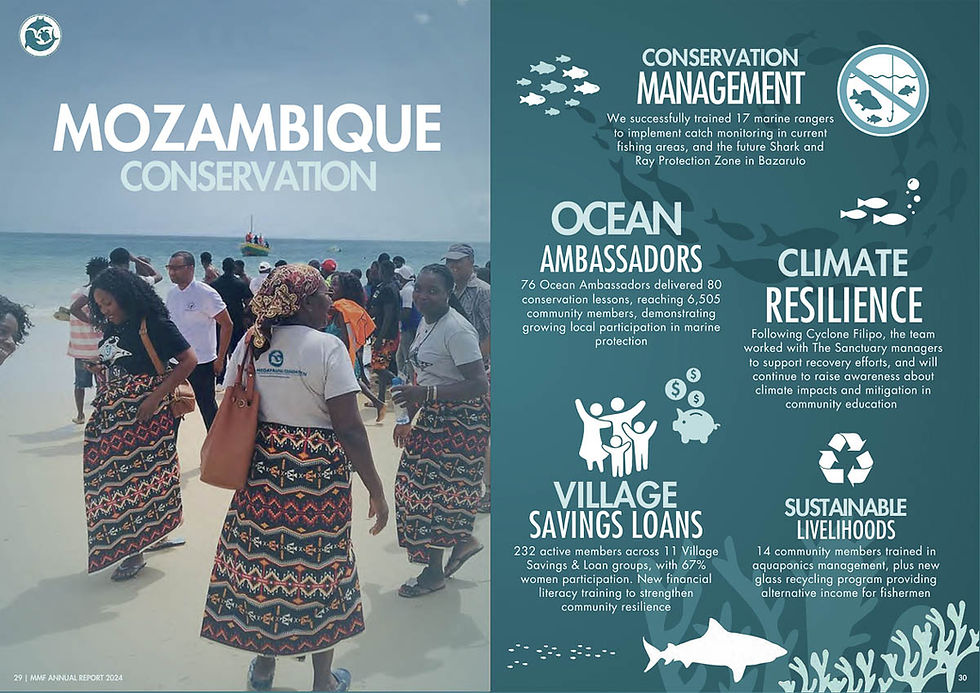
Ocean Guardians is MMF's education programme in Mozambique and is recognised by UNESCO. It works with children and young adults along the Inhambane coast on marine conservation and water safety, and on how a changing climate is affecting the reefs and fisheries their families depend on. More than a thousand children have been taught to swim through it. The intention is long-term. The scientists and policymakers who will make decisions about this coastline in 20 years are in school in Tofo and Vilanculos now.
Alongside it, the Sustainable Seas Project works on marine resource management with fishing communities, aiming to reduce destructive fishing practices and to help households protect the resources they depend on. Running through both is a longer objective. MMF sets out to build national research and conservation capacity in Mozambique, so that monitoring the coast does not rest permanently with visiting institutions.
From Tofo to the rest of the world
MMF was founded in Mozambique and now works well beyond it. Its whale shark programme runs projects in Tanzania, Madagascar, Oman and the Galapagos, and there are manta ray projects in Indonesia and Florida. Its research contributed to ISRA designations in Qatar, Oman, Madagascar and Mayotte as well as in Mozambique and Tanzania, where a decade of work at Mafia Island produced the Kilindoni Bay designation around a major whale shark feeding area.

The methods travelled with the organisation. Photo-identification, which the early Inhambane work helped develop, is now standard practice worldwide. MMF researchers have played an important role in the development and scientific use of two global photo-identification databases: Sharkbook for sharks and Manta Matcher for manta rays.
These platforms are used by researchers around the world to identify individual animals and track their movements over time. Both accept photographs from the public, which is covered below.
The findings travelled too. MMF lists coverage by the BBC, National Geographic, the New York Times, the Guardian, Netflix and others, and its own whale shark project page collects press items on the 2021 law and the Hope Spot. Public attention is part of what makes political action possible.
Dr Simon Pierce co-authored the first scientific textbook on whale sharks in 2021. What began as fieldwork on one stretch of African coast now feeds into Red List assessments, migratory species treaties and habitat designations covering oceans the organisation has never worked in.

What you can do
Support MMF directly
Donate. MMF is a registered 501(c)(3) non-profit organisation in the United States, which makes donations tax-deductible for US taxpayers.

Become a member if you would rather give regularly. Membership runs monthly, with an annual option, and MMF is specific about what each level funds:
$25 a month helps teach a child to swim each year
$50 supports a community workshop on marine conservation
$100 equips a new monitoring programme with the scientific gear it needs
Adopt a whale shark. The adoption supports MMF's global whale shark programme rather than one named animal, and comes with a personalised certificate, monthly research updates and a tax-deductible receipt, delivered within three working days. There is an optional birthday e-card if you are giving it as a present.

Long-term research depends on long-term funding. A photo-identification catalogue only becomes useful once it has run for many years, and the equipment, field teams and databases behind it have to be maintained long after the first paper is published.
Travel with them
MMF runs a small number of diving expeditions, and 100 per cent of the profit goes to its research. Participants work alongside MMF researchers on photo-identification, baited remote underwater video surveys, environmental DNA sampling and other fieldwork.
Current departures cover Indonesia, with these places remaining:
|  |
|  |
Dive responsibly if you go independently
How a boat behaves changes what the animal does, and the 2010 Tofo study measured exactly how. Across 411 interactions, sharks showed no avoidance at all once the boat stayed beyond 20 metres. When swimmers from a second boat entered the water with a shark already being watched, it turned away 60 per cent of the time, far more often than during single-boat encounters. The number of swimmers in the water, by contrast, had no measurable effect.
So, the questions worth asking an operator are how far off they put swimmers in, and whether they wait their turn when another boat is already with a shark.

Following guidance of this kind is voluntary in Mozambique. Elsewhere the same research carries more weight. In Madagascar, where MMF works alongside the Madagascar Whale Shark Project, a code built on that Mozambican study was written into an inter-ministerial decree in December 2023, making adherence compulsory for every operator in the country.
There is a self-interested case as well. Research at Isla Holbox in Mexico found tourist satisfaction rising with longer encounters and fewer people in the water.
Crowding an animal produces less time in the water, worse photographs, not more.
Send in your photographs
Holiday photographs do real scientific work. Upload a clear shot with the date and location, and software compares the spot pattern against existing records before a researcher verifies the match. If the shark has been seen before, the sighting extends what is known about its movements. If it has not, the catalogue grows.
For the best chance of a match, photograph the left side of the animal, particularly the area behind the gills where the pattern is most distinctive, and keep your distance rather than manoeuvring for the shot.
Whale sharks: Sharkbook, which Dr Simon Pierce oversees scientifically
Manta rays: Manta Matcher, which matches each animal's belly pattern
Looking ahead
Shark Week creates a concentrated moment of public interest. It can entertain, and it can also point attention towards the slow work behind real protection.
In Mozambique that work looks like a whale shark recognised from its spots, a bull shark detected by an underwater receiver and a zebra shark returning to an Inhambane reef. Scientific evidence alone does not protect sharks. It provides the information governments, communities and conservation organisations need to make informed decisions.
The zebra sharks resting on the sand off Morrungulo are still not protected under Mozambican law. Neither are the hammerheads or the wedgefish. The photographs, the tags and the genetic samples being gathered along that coastline now are the case that will eventually be put to the government, in the same way the whale shark evidence was put to it before 2021. That took 20 years. Shortening it for the next species is the work going on at Tofo, away from the cameras of Shark Week.
#SharkConservationInMozambique #MarineMegafaunaFoundation #WhaleSharks #BullSharks #ZebraSharks #Mozambique #Inhambane #BazarutoSeascape #MarineConservation #OceanConservation #SharkWeek #IndigoEarthFoundation
Notes
[1] Important Shark and Ray Areas are discrete parts of the ocean identified as important to one or more shark, ray or chimaera species. They are delineated by the Important Shark and Ray Areas project, run by the Shark Specialist Group of the IUCN Species Survival Commission, through a series of regional expert workshops. An area qualifies against criteria covering threatened species, species with restricted ranges, places used for feeding, resting or breeding, regular aggregations, and unusual diversity.
The purpose is to put the science in front of the people making decisions about the sea. An ISRA confers no protection and carries no legal weight of its own. What it produces is a published assessment naming the qualifying species and the evidence behind them, mapped in a public e-Atlas at sharkrayareas.org, which governments, planners and industry can consult when siting a protected area, managing a fishery or judging a development proposal. Without it, those decisions get made on whatever information happens to be to hand. The approach borrows from the Important Bird and Biodiversity Areas long used in conservation on land, and works alongside the Important Marine Mammal Areas mentioned later in this article.
[2] Mission Blue is an ocean conservation organisation founded in 2009 by Dr Sylvia Earle, the American oceanographer and former chief scientist of the US National Oceanic and Atmospheric Administration, following her TED Prize wish that year. Its Hope Spots programme identifies areas of ocean considered critical to the health of the whole, whether places already protected that need strengthening or places with no protection at all. Sites are nominated by people working locally, assessed against criteria covering habitat, rare or endemic species, cultural value and the potential to reverse damage, then reviewed by a Mission Blue council. There are around 140 worldwide. The designation carries no legal force of its own. What it provides is international visibility and a network that local organisations use when pressing their governments for formal protection.
Further reading
Marine Megafauna Foundation
Mozambique zebra shark research project, published under the regional name leopard shark
Manta rays and whale sharks now protected in Mozambique, January 2021
MMF's decades-long research pivotal in establishing new IUCN Important Shark and Ray Areas, January 2024
Third manta ray species, Mobula yarae, discovered in the Atlantic Ocean, July 2025
Scientific papers
Auditore, L.-M., Pierce, S.J., Prebble, C.E.M. et al. (2025) A 15-year time series shows major declines in whale sharks in southern Mozambique. Aquatic Conservation: Marine and Freshwater Ecosystems 35(10): e70224. Open copy
Womersley, F.C., Humphries, N.E., Queiroz, N. et al. (2022) Global collision-risk hotspots of marine traffic and the world's largest fish, the whale shark. Proceedings of the National Academy of Sciences 119(20): e2117440119
Queiroz, N., Humphries, N.E., Couto, A. et al. (2019) Global spatial risk assessment of sharks under the footprint of fisheries. Nature 572: 461-466
Prebble, C.E.M., Rohner, C.A., Pierce, S.J. et al. (2018) Limited latitudinal ranging of juvenile whale sharks in the western Indian Ocean suggests the existence of regional management units. Marine Ecology Progress Series 601: 167-183
Venables, S., Winstanley, G., Bowles, L. and Marshall, A.D. (2016) A giant opportunity: the economic impact of manta rays on the Mozambican tourism industry. Tourism in Marine Environments 12(1)
Haskell, P.J., McGowan, A., Westling, A. et al. (2014) Monitoring the effects of tourism on whale shark Rhincodon typus behaviour in Mozambique. Oryx 49: 492-499
Rohner, C.A., Pierce, S.J., Marshall, A.D. et al. (2013) Trends in sightings and environmental influences on a coastal aggregation of manta rays and whale sharks. Marine Ecology Progress Series 482: 153-168
Ziegler, J., Dearden, P. and Rollins, R. (2012) But are tourists satisfied? Importance-performance analysis of the whale shark tourism industry on Isla Holbox, Mexico. Tourism Management 33: 692-701
Pierce, S.J., Méndez-Jiménez, A., Collins, K. et al. (2010) Developing a code of conduct for whale shark interactions in Mozambique. Aquatic Conservation: Marine and Freshwater Ecosystems 20: 782-788
Marshall, A.D., Compagno, L.J.V. and Bennett, M.B. (2009) Redescription of the genus Manta with resurrection of Manta alfredi. Zootaxa 2301: 1-28
Dove, A.D.M. and Pierce, S.J. (eds) (2021) Whale Sharks: Biology, Ecology and Conservation. CRC Press
Conservation status and designations
IUCN Red List: whale shark (Endangered, 2025), bull shark (Vulnerable, 2021) and zebra shark (Endangered, 2024)
Important Shark and Ray Areas e-Atlas, IUCN SSC Shark Specialist Group
Greater Bazaruto, Pomene and southern Inhambane Province ISRA assessments
IUCN Marine Mammal Protected Areas Task Force, Bazaruto Archipelago and Inhambane Bay IMMA
Mission Blue, Inhambane Seascape Hope Spot, January 2022
Convention on Migratory Species, Rhincodon typus
Species profiles
Florida Museum of Natural History, Discover Fishes: bull shark and zebra shark
FishBase: Stegostoma tigrinum

Comments