
L’Île aux Enfants: Education at the Heart of a Community in Madagascar
Another powerful example of what word of mouth can build.
L’Île aux Enfants is based in Madagascar, in the heart of the swamp areas of Antananarivo. This organisation is dedicated to improving the lives of children and supporting the wider community. Everything is centred around education, with a clear belief that every child deserves a future if given the opportunity.
Although we have not yet visited the school or met the team in person, we had the opportunity to connect through an online call. Eric Hanrion, founder of the organisation, shared the story behind the project, its development, and where it stands today.

One person can make a change

It is striking how one individual’s determination can transform the lives of hundreds.
Eric Hanrion originally studied commerce but quickly realised his path lay elsewhere. In the early 2000s, he began teaching in Mayotte, working in particularly difficult conditions. He taught in informal settlements, supporting children who were often left behind due to deportations or unstable family situations. There, he saw first-hand how access to education could change lives.
In 2011, he moved to Madagascar with a clear ambition: to build a school and continue what he had started.
After one year on the ground, an unexpected opportunity arose. A friend, who had inherited land from his father, offered Eric the possibility to use it. The land was far from ideal, located in swamp areas, near a waste site, and surrounded by under-served neighbourhoods. Despite the challenges, Eric chose to move forward.
With initial support from a funding call, the first classroom was built in 2012, welcoming thirty-eight children.
From that modest beginning, the school has steadily grown. Today, it includes five buildings, supports more than three hundred and fifty students, employs thirty-five staff members, and continues to expand its activities.
Barriers to education in Madagascar
In Madagascar, education is officially compulsory between the ages of six and fourteen. In reality, access remains uneven.
Although primary education is theoretically free, families often face costs linked to uniforms, materials, and transport. Additional school fees are also common. Many children do not complete their education, and quality varies significantly depending on location.
In this context, L’Île aux Enfants plays a critical role within its neighbourhood.
Its work is structured around several key pillars:
Education
Professional integration
Neighbourhood development
Feeding programmes
A long-term objective of autonomy and sustainability
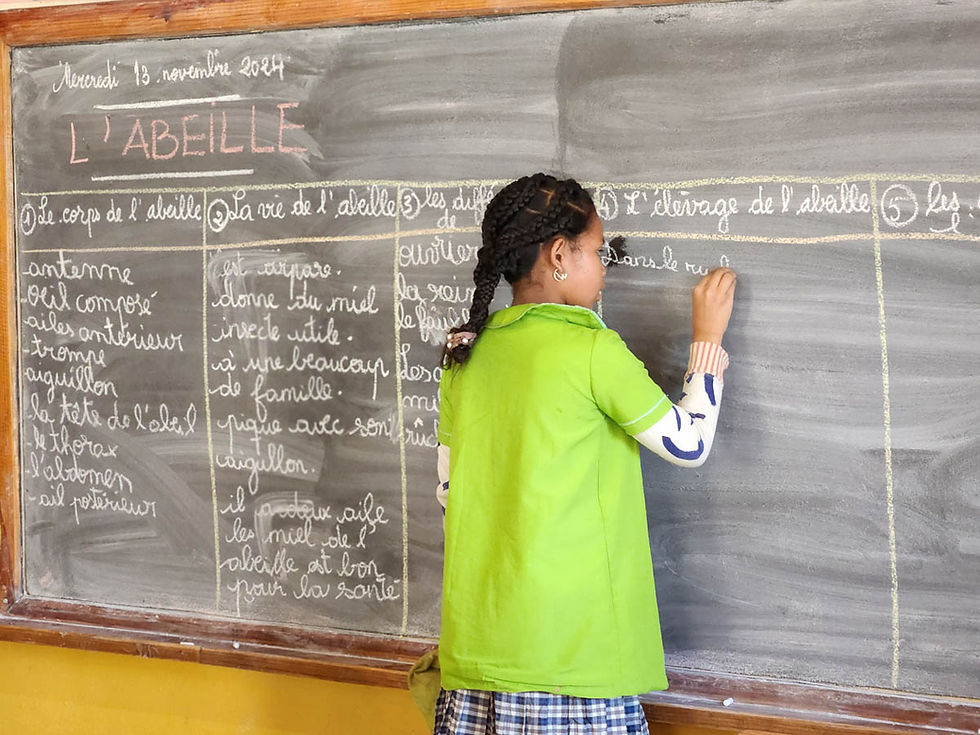


Education
At the centre of the project is a school designed for children whose families lack the means to provide consistent education.
The centre now supports over three hundred and fifty children and includes:
Four kindergarten classes
Five primary school classes
Four middle school classes
Three high school classes
Nineteen teachers
The school actively seeks to open children to the world. It welcomes visitors and organises regular school trips, creating exposure beyond the immediate environment.


A self-sustaining approach
Part of the learning experience involves reconnecting children with essential resources and everyday practices.
The organisation has developed several initiatives:
A raised garden introducing basic agriculture
Organic waste composting to teach recycling cycles
A poultry area providing eggs for the canteen
An aquaponic system with a two cubic metre tank, occasionally supplying tilapia
The infrastructure also includes:
Solar panels supporting energy needs
A water filtration system producing five cubic metres of potable water daily
Aquaponic system Organic waste composter
Opening minds
Education goes beyond the classroom.
Children are encouraged to explore, express themselves, and engage with the world through:
A school newspaper written by students
Annual school trips
Monthly cultural visits
Five cultural events organised each year
End-of-year and festive gatherings


Health, hygiene and sanitation
In an environment where sanitation conditions are often limited, health education is essential.
Children are taught daily hygiene practices and gain access to basic care. Preventive actions include:
Eye and dental screening campaigns
Deworming and vaccination initiatives
Support for health insurance enrolment

A healthy mind in a healthy body
Sport is an important part of development.
The school provides a multi-activity field where children can practise basketball, volleyball, and handball. A dedicated space is also available for younger children to support their motor development.
Beyond the school grounds, activities include:
Three annual sporting events
Two neighbourhood rugby competitions
These activities encourage teamwork and offer a valuable break from daily constraints.
Boarding facilities
The organisation operates a boarding facility accommodating forty children, evenly split between boys and girls.
The centre includes:
Two educators
Study rooms
A music classroom
Digital learning
Access to digital skills is a key factor for future employment.
The school provides:
A computer room with eighteen computers
Internet access
A dedicated teacher
Introducing these tools early significantly increases future opportunities.

Feeding the children
The canteen plays a vital role.
Beyond providing daily balanced meals, it introduces children to new tastes and encourages autonomy. Each day, a group of students participates in cleaning tasks, building responsibility.
In addition to the school canteen, the organisation also supports a broader feeding programme, providing meals to between eight hundred and one thousand two hundred children daily in the neighbourhood.
Cooking in progress Happy chef presenting her dish Children feeding Smiling child in front of her plate
Information and orientation centre
Helping children understand their future possibilities is essential.
The centre offers guidance through:
Individual counselling
Access to computers for research
Conferences and company visits
It also provides practical training in:
Cooking
Teaching
Construction
The training programme lasts two years and begins at the age of sixteen. It combines practical work, internships, and professional supervision.
By the age of eighteen, students are ready to enter the workforce with real skills and experience.

Neighbourhood development
L’Île aux Enfants extends its impact beyond the school.
Actions include:
Access to water and electricity connections
Installation of water points
Rehabilitation of pedestrian bridges
Awareness campaigns on family planning, violence, climate risks, and environmental protection
The organisation also contributes to community life through local events and celebrations.
Looking ahead
What began with a single classroom has grown into a deeply rooted initiative supporting both children and their community.
The next steps include:
Opening a new kindergarten class in September 2026, welcoming thirty additional children
Developing a new training centre on a one thousand two hundred square metre site located forty-five minutes from the current school
Focus on bakery, pastry, and catering
On-site service for visitors
Construction pending fundraising
Installation of a biodigester to convert food waste into gas for cooking
L'Île aux Enfants, Current needs
To continue its development, the organisation has identified several priorities:
Sponsorships for children
Fifteen to twenty computers
Furniture for the kindergarten
Like many non-profit organisations, L’Île aux Enfants relies heavily on donations. Unlike grants, which are often restricted, donations allow flexibility to support daily operations, including food, salaries, and essential services.
Indigo Earth Foundation support
Indigo Earth Foundation began supporting L’Île aux Enfants in 2025 through the sponsorship of a child. This support covers education, nutrition, and medical care, with a long-term commitment throughout the child’s schooling.

How you can support
Direct support
You can contribute through monthly or annual donations. Regular support provides stability and allows the organisation to plan ahead and support more children.
Every contribution makes a difference.
Other ways to contribute
Visit the school when travelling to Madagascar and gain first-hand insight
Volunteer your time and skills, ideally with a specific project or English lessons
Raising awareness
Support can also take the form of visibility:

Learn more through the Indigo Earth Foundation website:


Comments