
Four Years of White Rhino Conservation on Communal Land in Hwange | Zimbabwe
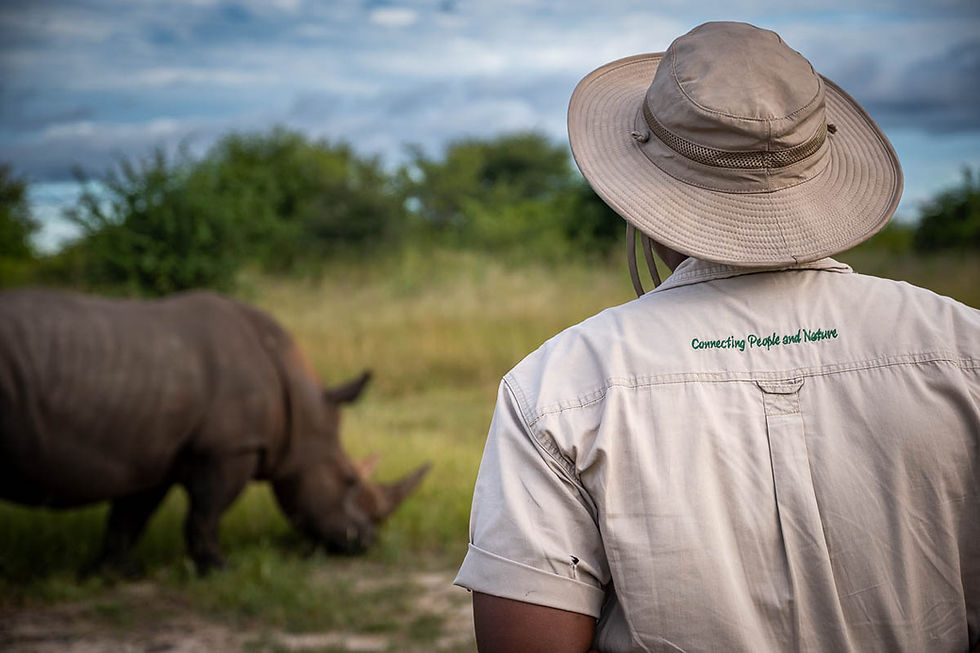
If you ask CRCI (Community Rhino Conservation Initiatives) about their anniversary date, they will answer without hesitation. For them, the true anniversary is the reintroduction of the first white rhino bulls into the Hwange landscape after the species disappeared from the region in the early 2000s due to poaching.
On 22 May 2022, Thuza and Kusasa, two rhino bulls from Malilangwe Reserve, completed a seventeen-hour journey of more than 750 kilometres to reach their final destination and new home, the first community sanctuary in Tsholotsho District. The sanctuary was created by the Community Rhino Conservation Initiative (CRCI), with the support of Imvelo Safari Lodges.
Those rhinos cannot know the importance of what they represent for the region, for local communities, and for tourism. Their arrival marked a major step within a long-term vision built around three interconnected pillars: Nature, Tourism & People.
This project required decades of engagement, planning, and determination to become reality. It also brought together a wide range of participants, including the Zimbabwe Parks and Wildlife Management Authority (ZPWMA), responsible for wildlife and protected areas, the Rural District Councils (RDC), which manage wildlife within communal areas, local committees involved in natural resource management and community relations, as well as Traditional Leaders.
The initiative was designed to create a positive cycle in which tourism revenue supports communities, communities contribute to conservation efforts, and healthy wildlife populations strengthen the long-term future of tourism in the region.

In practical terms, CRCI manages rhino sanctuaries located on communal land and visited by international tourists. Revenue generated through tourism contributes to improving the livelihoods of communities living adjacent to the sanctuaries by:
Creating a buffer between the National Park and neighbouring communities, helping reduce human-wildlife conflict
Supporting and funding community projects linked to education, healthcare, essential needs, and climate resilience
Employing local scouts
Creating additional sources of income within areas that largely depend on cattle and livestock for survival
Context of the Project
The story begins long before the arrival of Thuza and Kusasa. It is closely linked to the history of Imvelo Safari Lodges, its founder and long-term vision, Mark Butcher, and years of engagement with the communities bordering Hwange National Park.
To understand the scale and significance of this initiative, it is important to first understand the environment in which it operates.
Imvelo and CRCI operates in Tsholotsho District (in green below), in Matabeleland North Province, particularly within Wards 1, 2, 3, 4, and 5, adjacent to Hwange National Park.

Here is the location of the different wards highlighted in blue.

The project area lies within the KAZA Transfrontier Conservation Area. The lighter shaded section shown in yellow defines the official KAZA boundary within Matabeleland North District.

Challenges Facing the Region
This area faces a combination of social, economic, and environmental pressures that contribute to difficult living conditions and intensify human-wildlife conflict.
Proximity to Hwange National Park
Tsholotsho District lies directly adjacent to Hwange National Park, which is unfenced. Wildlife therefore moves freely between protected areas and neighbouring communal lands, creating constant interaction between people and animals.
Elephant Population
The region forms part of the Kavango-Zambezi (KAZA) landscape, which contains one of the largest elephant populations in Africa, representing more than half of the continent’s savanna elephants.
In several areas, elephant densities exceed ecological carrying capacity
Seasonal movement into communal lands is frequent due to water and forage pressures
Crop-raiding is widespread, particularly during the agricultural season
Many households experience repeated crop losses, directly affecting food security
Human-Wildlife Conflict
Human-wildlife conflict (HWC) in the region is not occasional. It is a persistent and structural issue affecting daily life across many communities.
The main species involved include:
Elephants, responsible for crop destruction, infrastructure damage, and risks to human safety
Lions and hyenas, which frequently prey on livestock
The conflict results in:
Crop destruction
Livestock losses
Human injuries and fatalities
Across the KAZA region, HWC is recognised as one of the most pressing conservation challenges, involving crop damage, livestock predation, and threats to human life. (Source: KAZA TFCA Human wildlife conflict mitigation measures 2016).
This situation contributes to:
Negative perceptions of wildlife
Retaliatory killing and illegal activities
Reduced support for conservation efforts
An Area Facing Long-Term Hardship
Tsholotsho is marked by structural poverty, environmental pressures, and limited economic opportunities.
Climate
The district lies within Agro-ecological Regions IV and V, characterised by:
Low and erratic rainfall, generally below 400 mm annually, see map below
Frequent droughts
Poor agricultural potential
As a result, livelihoods remain highly vulnerable and low-yield, with most households relying on subsistence farming and livestock.

El Niño and Recurrent Droughts
Recurring El Niño events are a major driver of prolonged droughts in Zimbabwe, with increasing frequency and intensity linked to climate change.
These climate events have severe consequences for rural livelihoods, including:
Crop failure and declining agricultural productivity, leading to widespread food insecurity
Increased water scarcity, forcing communities to depend on limited and shared water sources
Deteriorating health conditions linked to malnutrition and increased exposure to disease
Increased livelihood pressures, including livestock losses and reliance on alternative means of survival
In Tsholotsho, these climate shocks intensify existing vulnerabilities, increasing food insecurity, water stress, and dependence on natural resources.
Unemployment
Formal employment opportunities remain limited within Tsholotsho District. Many households therefore depend on subsistence agriculture, informal economic activities, or migration as sources of income.
Matabeleland North remains among the most vulnerable regions in Zimbabwe across several socio-economic indicators, including income levels, food security, and access to essential services.
Food Security
Food insecurity in the district is chronic, seasonal, and driven by several interconnected factors:
Low agricultural productivity
Climate variability
Wildlife-related crop losses
Many households face recurring food shortages and long-term dependence on external assistance.
Access to Water, Sanitation and Hygiene (WASH)
Water scarcity remains a persistent challenge in Tsholotsho District, particularly during the dry season, when water availability becomes limited and unreliable.
Water points are often shared between people, livestock, and wildlife, increasing pressure on already scarce resources and intensifying interactions between communities and animals.
This situation contributes to heightened health risks, increased human-wildlife conflict around water sources, and reduced agricultural productivity due to insufficient water for crops and livestock.
Access to Social Services
Access to essential services, including education and healthcare, remains limited throughout Tsholotsho District.
Infrastructure is sparse and often under-resourced, with schools and health facilities located far from many communities. Long travel distances, combined with limited transport options, restrict access to quality education and healthcare, particularly for vulnerable households.
Livestock as a Primary Source of Wealth
Livestock remains one of the principal forms of wealth and an essential source of livelihood for many households in Tsholotsho District.
However, livestock is highly vulnerable to predation from wildlife, particularly lions and hyenas. These losses carry serious economic consequences for households and directly affect income stability and resilience.
Rhino Extinction Due to Poaching
The historical rhino population in parts of Zimbabwe, including areas surrounding Hwange, was severely affected by poaching, leading to localised extinction.
The white rhino population in Hwange National Park disappeared after years of sustained poaching pressure.
At national level, Zimbabwe’s rhino populations have experienced major declines over recent decades, largely driven by the international demand for rhino horn. Black rhino numbers fell dramatically from approximately 3,500 individuals in the 1970s to around 300 by the mid-1990s.
Despite strengthened anti-poaching efforts and continued conservation work, illegal hunting and wildlife crime remain major threats. The high value of rhino horn continues to drive organised poaching networks and cross-border trafficking, requiring long-term law enforcement, regional cooperation, and community participation.
(Source: Rhino-Policy-2020-2024.pdf)
Subsistence Poaching
Subsistence poaching and bushmeat hunting remain ongoing challenges within the area, driven by poverty, food insecurity, and limited livelihood opportunities.
These activities weaken conservation efforts, contribute to biodiversity loss, and threaten the long-term stability of the ecosystem.
Health
Water, sanitation, and hygiene conditions within Tsholotsho District remain a serious public health concern.
According to the ZimLAC 2025 Rural Livelihoods Assessment, 56.5% of households in Tsholotsho practise open defecation, one of the highest rates recorded in Matabeleland North.
Limited sanitation infrastructure increases exposure to waterborne diseases, particularly in areas where water sources are shared between people, livestock, and wildlife.
Poor sanitation conditions, combined with water scarcity and food insecurity, further increase health vulnerabilities and negatively affect community wellbeing.
Soil Degradation
Soil degradation remains a major constraint on agricultural productivity across the district.
Poor soil quality, combined with low and erratic rainfall, reduces crop yields and limits resilience to climate variability.
Contributing factors include overgrazing, unsustainable land-use practices, and environmental degradation linked to prolonged drought conditions.
Migration
Tsholotsho District experiences sustained out-migration driven by limited local economic opportunities.
According to the ZimLAC 2025 Rural Livelihoods Assessment, 8.7% of households report migration to urban areas, and 7.0% report migration outside Zimbabwe, reflecting both internal and cross-border movement.
The main driver remains access to employment opportunities unavailable within the district.
Over time, this movement contributes to labour shortages at household level, increases dependency ratios, weakens local productive capacity, and reinforces cycles of poverty and vulnerability.
Main Stages of the RHINO CONSERVATION Project
It is within this context that Imvelo Safari Lodges was founded and began supporting local communities, years before the creation of the Community Rhino Conservation Initiative (CRCI) in 2017.


Impact
Four years after the reintroduction of rhinos onto communal land, the project has already contributed to the growth of tourism and the development of community-led projects across the region.
This long-term commitment is documented through the annual factsheets published by CRCI.
CRCI 2020 Factsheet CRCI 2021 Factsheet CRCI 2022 Factsheet CRCI 2023 Factsheet CRCI 2024 Factsheet CRCI 2025 Factsheet
Wildlife Conservation and Ecological Regeneration
The project has restored and protected ecological functions in areas adjacent to Hwange National Park.
In partnership with communities in Ward 3, more than 3,000 hectares of communal land have been allocated as rhino habitat.
At present, four male white rhinos have been reintroduced, with two additional rhinos expected in 2026 and a larger translocation planned for 2027.
Fifty-seven local scouts, including three women, are responsible for rhino protection and monitoring activities.
The rhino sanctuaries and surrounding buffer zones also protect vegetation from excessive elephant and cattle grazing pressure, encouraging the regeneration of bushland and tree cover.
Proactive scrub management across more than 1,000 hectares has improved grass growth and supported the return of plant species and wildlife, including bushbuck populations absent from sections of the National Park itself.
Rhino monitoring operations generate approximately 130,000 data records each year, contributing to behavioural research and adaptive conservation management.
Community Livelihoods and Poverty Reduction
Tourism revenue and associated charitable programmes support essential services within communities neighbouring the National Park.
Completed in 2022, Ngamo Clinic has already treated more than 9,300 patients.
Since 2011, the mobile eye and dental programme has treated more than 55,000 patients and provided over 340 free cataract surgeries.
Employment opportunities linked to conservation and tourism have expanded significantly. More than seventy people from neighbouring villages now work permanently within Imvelo’s lodges and guiding operations.
Sewing cooperatives have also received training, equipment, and supplies, including more than forty sewing machines.
Community members generate additional income through the sale of locally made crafts to visiting tourists, who spend approximately US$30,000 annually at village markets.
Access to clean water has improved through the drilling and maintenance of more than eighty boreholes.
Food security initiatives include:
More than 500,000 school meals delivered annually across sixteen schools
Three irrigated village food gardens, with additional projects under development
More than 200,000 kilograms of maize meal distributed to households during the past five years
Educational support includes more than 140 school bursaries each year, alongside wildlife education opportunities for over 1,700 students and community members.
Infrastructure investments have included:
Thirty-six teacher cottages
Classroom blocks
Accommodation facilities
Toilet blocks
More than 70,000 textbooks distributed over the past decade
Two tonnes of stationery supplied to local schools
Community Income Generation
Tourists visiting the rhino sanctuary contribute directly to conservation and community development through a dedicated community and conservation levy included within their safari experience.
Forty percent of this levy goes directly to villages and funds projects selected through local governance structures.
The remaining sixty percent supports rhino protection operations and scout salaries.
As scouts are recruited locally, much of this income returns directly into surrounding communities.
Climate Resilience
The project has also strengthened resilience to climate pressures through improved land and water management.
Irrigated village gardens now allow year-round food production, with three established projects and two additional gardens under development.
Water supplied through twenty-six solar-powered pumps inside the National Park and surrounding conservation areas delivers billions of litres annually, supporting large wildlife populations, including an estimated ten thousand elephants.
This reduces seasonal wildlife movement into communal lands.
Habitat restoration work, including scrub clearing and grassland regeneration, has also improved grazing conditions for both livestock and wildlife.
Human-Wildlife Conflict Reduction
Human-wildlife conflict has been reduced through the construction of innovative wildlife-proof fencing.
More than 18.5 kilometres of fencing now protect villages, and an additional 10 kilometres of National Park fencing have been rehabilitated to strengthen buffer zones between Hwange National Park and neighbouring communities.
These measures help reduce:
Elephant crop-raiding
Livestock predation by lions and hyenas
Illegal access routes used by bushmeat poachers
In addition, 500 kilometres of fireguards have been cleared to protect habitats and reduce wildfire risks.
Community-Led Conservation
One of the project’s most significant outcomes has been the gradual shift in how wildlife is perceived within local communities.
Wildlife is increasingly viewed not only as a source of conflict, but also as a contributor to livelihoods, employment, and future opportunities.
The Community Rhino Conservation Initiative reflects this transformation, with communities actively supporting the return of white rhinos onto communal land.
Former subsistence poachers have become wildlife protection scouts, gaining stable salaries, food support, and educational opportunities for their families.

Local governance structures also ensure transparency and allow communities to participate
directly in decisions regarding conservation revenue and development funding.
This work received international recognition in April 2026, when Imvelo Safari Lodges, through its work coordinated via CRCI, received the Silver Award for Regenerative Tourism at WTM Africa. The award recognises tourism initiatives that actively restore ecosystems and contribute to the long-term development of local communities.
Plans for the Future
Future plans focus on strengthening and expanding the existing model through the continued growth of the Community Rhino Conservation Initiative and the development of additional community projects.
An equally important priority is consolidating what has already been established and ensuring long-term ecological, social, and economic resilience across the region.
From a conservation perspective, the next phase aims to progress towards a larger connected conservation area along the boundary of Hwange National Park.
This will include securing additional communal land through voluntary community agreements, completing wildlife fencing where necessary, and expanding suitable habitat capable of supporting a healthy and protected rhino population alongside other wildlife species.
Future rhino translocations will focus on increasing the white rhino population within the communal sanctuaries.
Current plans include:
The translocation of two additional male rhinos in 2026
A larger translocation programme planned for 2027 and 2028 involving twenty-four rhinos, including females and calves
The initiative also plans to work with additional communities further west, encouraging the allocation of communal land to rhino conservation in order to expand both the protected area and the wider benefits generated by the project.
Community development projects will continue to evolve according to priorities identified locally and supported through donor funding.
Existing governance structures will continue guiding investments linked to:
Healthcare
Education
Food security
Access to clean water
Income diversification
Particular attention will remain focused on maintaining existing services while progressively extending support to more remote villages as funding and operational capacity increase.
New tourism experiences will also be developed to strengthen conservation financing and improve visitor access to lesser-known areas of Hwange.
Examples of projects planned for the coming years include:
Extension of the wildlife sanctuaries
Introduction of additional rhinos to establish a sustainable breeding population
Development of additional irrigated food gardens
Expansion of wildlife-proof fencing to protect communities
Creation of a junior academy dedicated to training community scouts
Construction of additional classrooms and teacher cottages
The map below shows the location of the future sanctuary extensions.

A Model That Could Inspire Other Regions
The model developed by the Community Rhino Conservation Initiative offers an example for regions facing similar conservation and community challenges.
It was created in response to the specific ecological, social, and governance realities of the Hwange landscape and has not yet been directly replicated elsewhere.
However, the approach may offer valuable lessons for other areas, including regions within the Kavango-Zambezi Transfrontier Conservation Area, provided it is adapted carefully to local conditions and governance systems.
Any future replication would require strong local participation, context-specific governance structures, and alignment with existing land-use practices.
Several core elements define the approach:
The use of communal land for conservation
Community participation in the management of conservation revenue
Tourism as a long-term financing mechanism supporting both conservation and local development
The initiative demonstrates how wildlife conservation, ecosystem protection, tourism, and community development can function together within the same long-term model.
A Closer Look at the White Rhinos of CRCI
Thuza and Kusasa
Thuza and Kusasa were the first white rhinos introduced into the first sanctuary established by CRCI.
The two bulls came from Malilangwe Reserve and were carefully selected for the translocation.
Born in 2014 and 2015 respectively, the pair were young, not yet sexually mature, and unrelated despite being inseparable companions.
The choice proved successful. Both rhinos adapted rapidly to their new environment, established their territories, and became accustomed to the constant presence of their community scout escorts working around the clock.
They remain closely bonded and have become a remarkable sight for visitors, including members of neighbouring communities.
Visitors can discover the scale of the conservation work, walk alongside the rhinos, observe the work carried out by the community scouts, and better understand the complexity of protecting wildlife on communal land.
The names of the two rhinos also carry symbolic meaning.
Thuza means “to strike”, reflecting the determination to move the project forward and create meaningful impact.
Kusasa means “tomorrow”, representing hope for future generations.
On 22 May, CRCI marks the anniversary of their arrival into the Hwange landscape four years ago, when the two rhinos travelled by truck inside transport crates and were welcomed by local communities upon arrival.
Their translocation represented a defining moment within a much larger long-term initiative.
Thuza Thuza and Kusasa Kusasa Thuza digging the soil Thuza and Kusasa Kusasa sleeping
Mlevu and Asenze
In 2024, Mlevu and Asenze joined the project and were introduced into the second sanctuary.
Mlevu was named after Baba Mlevu, one of the Traditional Leaders from Tsholotsho who played an important role in the creation of the project and the establishment of the sanctuaries.
Asenze means “let’s go”, continuing the project’s theme of action, commitment, and forward movement.
Like Thuza and Kusasa, both rhinos also came from Malilangwe Reserve. The two bulls were not sexually mature at the time of translocation.
They have adapted well to their new surroundings, although they are more independent and are not always seen together.
Additional white rhino bulls are expected to be translocated during 2026. The exact dates have not yet been confirmed, as operations depend heavily on road conditions and the possible organisation of an alternative rail translocation.
 |  |
Would You Like to Experience It Firsthand?
Indigo Earth Foundation organises conservation and safari group expeditions designed to combine meaningful conservation participation, time with local communities, and an authentic safari experience in Zimbabwe.
The upcoming departures are scheduled for:
12–25 July 2026
3–16 October 2027
A limited number of places remain available for the 2026 departures.
This fourteen-day journey combines hands-on conservation activities alongside local communities and wildlife experiences around Hwange National Park, followed by a safari in one of the most remote regions of Zimbabwe.
What makes this expedition different is the balance between direct involvement in conservation work and a genuine safari experience. Participants do not simply observe conservation projects from a distance. They actively take part in community and wildlife-related activities throughout the journey.
For participants, this includes:
A more meaningful travel experience through direct participation and cultural exchange with local communities
Access to conservation initiatives and remote areas rarely visited through conventional tourism
A deeper understanding of the relationship between wildlife conservation and rural communities
Game drives and safari activities throughout the expedition, including a remote wilderness safari in southern Hwange
Time spent in some of Zimbabwe’s most isolated and wildlife-rich landscapes
A strong sense of purpose alongside the adventure
The expedition begins with two days in Victoria Falls, including a visit to one of the Seven Natural Wonders of the World, a sunset dinner cruise on the Zambezi River, and time exploring the surrounding area and local conservation initiatives.
During the conservation section of the journey, participants stay at Mlevu Rhino Camp and travel daily to surrounding conservation areas and neighbouring communities.
Activities include:
Rhino monitoring
Spoor identification
Waterhole and pump maintenance
School visits
Village support projects
Anti-poaching support activities
Time spent alongside the Cobras Community Wildlife Protection Scouts
Game drives within Hwange National Park are also included during the conservation section of the expedition.
The safari section then moves south to Jozibanini Camp, an exceptionally remote camp located in one of the wildest parts of Hwange.
With no neighbouring lodges nearby, wildlife encounters feel entirely different from those experienced in more heavily visited safari areas.
Elephants regularly gather at the camp waterhole only metres from the underground hide, creating extraordinary viewing opportunities.
Activities at Jozibanini include:
Game drives
Bush walks
Mountain biking
Wildlife tracking on foot
You can watch the recorded YouTube presentation detailing the itinerary, conservation activities, accommodation, safari experience, and daily life during the expedition here:
The complete itinerary for the expedition are available here:

Places remain intentionally limited in order to preserve the quality of the experience and the level of engagement with local communities and conservation teams.
Adopt a Rhino
You could also support their work by adopting one of their rhino, and receive regular updates.

#RhinoConservation #WhiteRhino #Hwange #Zimbabwe #WildlifeConservation #ConservationTravel #SustainableTourism #RegenerativeTourism #HumanWildlifeConflict #ConservationAfrica #SaveRhinos #AfricanWildlife #EcoTourism #HwangeNationalPark #KAZA #ConservationInAction #WildlifeProtection #IndigoEarthFoundation #CommunityRhinoConservationInitiative #ImveloSafariLodges #ImveloTrust #ImveloCommunityHealth

Comments